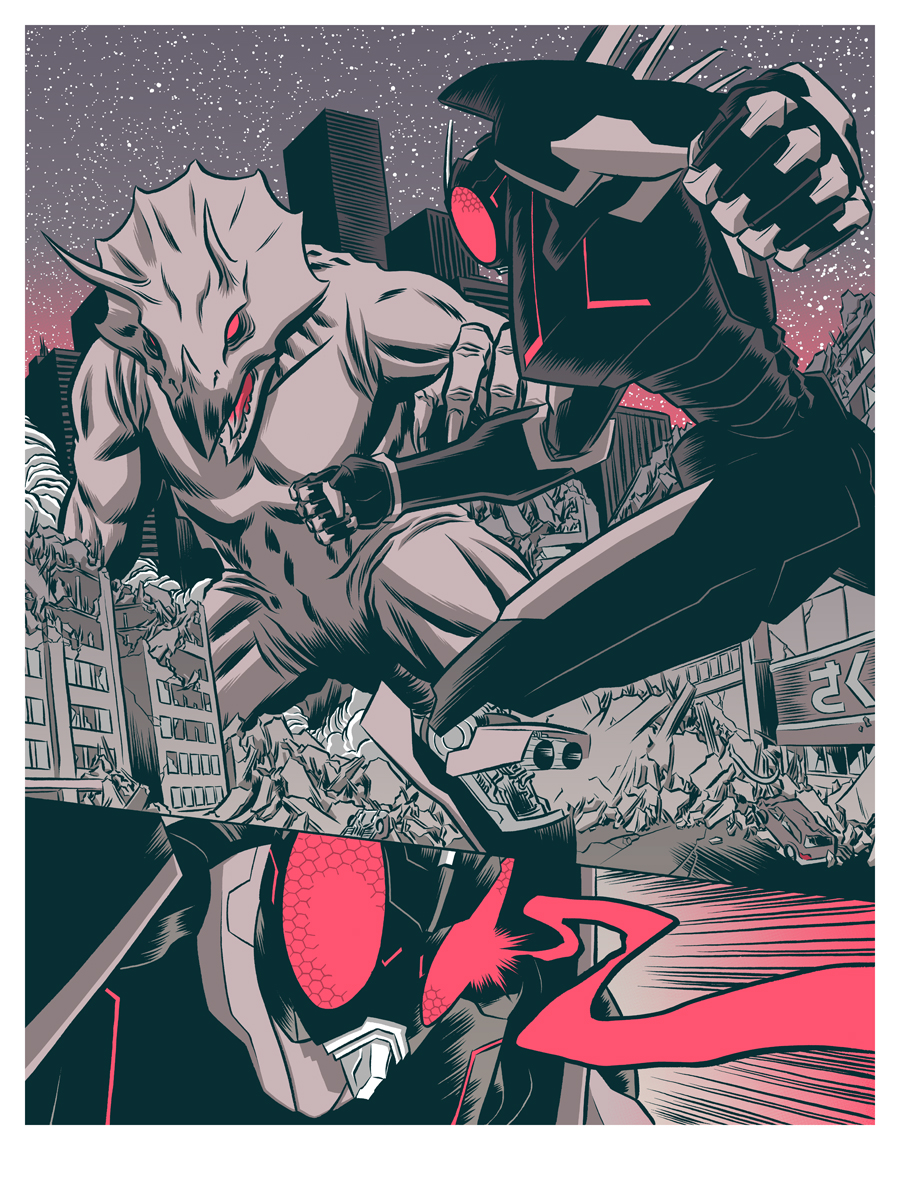
Geoff Sebesta is the man behind the ongoing Cloudhopper books and the hilarious giant-sized mini-comic Busta/Lovecraft (both can be found at unnecessaryg.com). He is co-editor of Rocksalt found at fictioncircus.com/rocksalt and at finer Austin establishments.
Matt: As someone relatively new to the independent comic book scene
in Austin, I 've been impressed by how expansive and vibrant the
community is. I get the impression that you have been very involved
long before Rocksalt. I was wondering if you could give us any
insights into the community?
Geoff: Thanks! Yeah, I've been "part of this community" for a while now, and
it's nice to be noticed. Basically we are in the Fourth Great Epoch of
Austin Art (unless you count things that happened before the 60s, which
are lost to history), also known as the Era of Sketchgroup [Austin
Sketch Group/ASG], and I'm proud to be a part of it.
Although there are huge amounts of the Austin scene completely
unknown to me, I know a lot of the people who are doing comics in this
town. I don't really know why, I just enjoy the company of artists.
Artists are the only people who consistently know how to have a good
time without breaking everything, and those two things are important to
me. Artist parties tend to be filled with interesting people saying
interesting things. Last night my artist housemates and I spontaneously
did a fan re-enactment of Cloverfield, and we weren't even drunk. I
really like that.
Matt: How did you get involved in the Austin scene?
Geoff: I was invited to an early meeting of Sketchgroup by a crazy man. Then I
didn't leave, for eight years straight. I picked the right spot to stand
and watch the scene coalesce.
Matt: Has ASG helped and/or challenged you to improve and expand
your art?
Geoff: Oh, it revolutionized my art. It's totally fair to say that Sketchgroup
made me the artist that I was...about four years ago, which made me the
artist that I am today....? I guess?
But yes, at the beginning Sketchgroup and the Austin scene were
completely inspirational. At this point I think I have enough momentum
to keep going on my own, and I don't think criticism is quite as
essential to me now that I've trained my eye to see when I do something
that doesn't look good. These days I'm usually a lot more concerned with
the next drawing than the last, so the role of criticism and
inspiration is not as great as it used to be. I guess it helps that I'm
married to my best collaborator and critic, that probably has something
to do with it.
Sketchgroup is still as important to me as it ever was, but my wife and
my child are the most important things have ever been to me in my life,
so Sketchgroup has been knocked down a peg. Fortunately Sketchgroup
requires no effort at all. It just keeps sketchin'.
Matt: How do you see the community developing in the future
and what is the role of
Rocksalt?
Geoff: For quite a while after the Scanner Darkly thing ASG was a pretty hard
core of comic book aficionados who worked together on all their
projects. That's where Sequentulär and a bunch of other projects come
from. We went through a long period where there was somebody, usually
somebody who hadn't been coming to meetings for a while, who wanted to
"revitalize Sketchgroup." Then they stopped trying to do that, and
suddenly ASG exploded. It was around the same time Rocksalt started, so
there was probably a relationship, but I really think it was just
mysterious cultural movements that were too deep to perceive. All of a
sudden the average Sketchgroup meeting was bigger than a big Sketchgroup
meeting used to be, and when we have one of those odd days where
everyone shows up at once we literally crowd all the other customers out
of the coffee shop.
Now there are so many projects coming out of ASG that I can't keep
track. There are comics, video games, novels, new publishing ventures,
paintings, youtube videos, sculptures... basically anything that you can
make, somebody in Sketchgroup is busy making.
I have no idea where it's going from here, and it's not really that
important where it goes. The core concept of what ASG is has become
essentially indestructible, and even if we all left town tomorrow there
would probably still be a Sketchgroup.
I consider that an achievement
on all of our parts. The reason it's indestructible is because it
doesn't do anything. There are no dues, no rules, no rites of
initiation. We all agreed to keep it simple, and that will probably let
it live forever. ASG doesn't exist to accomplish great things, but to
provide a central base from which great things can be done. It's
perfectly accurate to call
Rocksalt an ASG project, since the majority
of talent in the magazine are culled from ASG, but there's a whole lot
of ASG that has nothing to do with
Rocksalt.
Rocksalt, if we can ever figure out how to plug the advertising monies
into it, will hopefully also last forever. There is no reason not to
why it wouldn't. Jeanne Thornton and I are essentially printing out the
internet. Of all the tasks associated with running the magazine,
filling the issue with art is by far the easiest. We will probably
always remain close to our home in ASG, but once we get it going we will
"salt" some other cities too. Even when we have distribution in thirty
cities and twenty nations and our own diamond-plated newspaper boxes
Rocksalt will remain a showcase for the best cartoon work in Austin,
because we live here. Probably gonna keep living here. This will
probably have some sort of synergistic effect because, hey, Rocksalt is
good publicity. But we are the little remora feeding off the big sharks
of Austin and the internet, and that shouldn't change.
Matt: One of the first books I picked up at an Austin comic con was
the first volume Cloudhopper. This may say more about me but
I can't think of any comic books even remotely similar in tone or
content as Cloudhopper and
work found on your web page megaTexas. Are there comics that
inspire the stories you tell and how you tell them?

Geoff: Hmm...Keith Giffen, Moebius, Dave Mazzucchelli, George Herriman....I
find it easy to conceal my influences because there are so many of them
and I steal so liberally from all of them. When it comes to storytelling
and composition, I was raised in the Marvel House Style. I think a lot
about composition. Giffen is the master of composition and
storytelling. Modern comics storytelling owes him a huge debt. Chris
Ware was to the 90s what Giffen was to the 80s, but it's probably even
harder to see when I'm ripping him off because I don't draw like he does
at all. I'm just not careful enough to draw like that.I think the reason most people can't detect who I'm stealing from is my
odd approach to figure drawing. I take a lot of life drawing classes, so
I don't stylize my characters in a comic book way. Characters are drawn
according to figure drawing proportions (not heroic anatomy
proportions) and rendered to the best of my abilities, which is pretty
scary if you look at some of the crappy figures I've drawn.
Right now I'm reading BPRD, Prophet (postapocalyptic as it should be;
terminally weird), the Unwritten, an old Tezuka GN called Ayako, and
catching up on Secret Six.
Matt: Are there any strong influences from film or literature in your work?
Geoff: I read a lot, watch a lot of movies, read a lot of comic books. I've
never really been into video games, I use the time most people use on
games to consume massive chunks of static media. I'm not saying it's
better because obviously it isn't. I'd have a hard time arguing that
watching a movie is a more participative act than playing a game.
I was really into the ideas of Stanley Kubrick, and how his
innovations in set design have really come to dominate the film world.
But I don't really enjoy his movies as much as his ideas. His movies are
sort of mean and boring, except Eyes Wide Shut, which is a fairy tale
about mean and boring people. But I do like his way of hiding things in
plain sight. I love the Sopranos, the way they tie symbolism so closely
to the narrative. I love the dialogue of Mamet and Stoppard. I think
Wes Anderson has come closest to creating a purely filmic language that
simply could not exist in any other medium. I've seriously come to
believe that Paul Verhoeven is the greatest satirist of film history and
that Showgirls is an underappreciated masterwork the equal of Starship
Troopers or Robocop (but not Total Recall, the greatest Philip K Dick
film of all time). Right now I'm really into old Disney movies, believe
it or not, though I watch them with the sound off (Pinocchio is a
gorgeous film but the old Disney orchestra is so obtrusive and cloying)
and anything in French.
I love Thomas Pynchon. I like the multiplicity of inputs and the
"everything goes" narrative style and the abstruse humor. I am really
into Crowley's Little, Big and Milan Kundera's The Unbearable Lightness
of Being and books with unhappy endings. If you are not more than a
little sad at the end of Cloudhopper I will not have done my job.
Matt: The more I read your work the harder it is for me to recall
static panels. Now that you mention it I can see how some of this
might come from your life drawing. I feel that there is playful
looseness to your lines that conveys motion not just between panels
but within them as well. What inking tools do you use to pull it off
technically.
Geoff: I use a uniball vision pen, a sharpie, and Photoshop. The reason it
looks like I'm a better inker than I am is because I fake ink textures
with Photoshop (at this point Busta/Lovecraft is probably about 60%
computer but I hope you can't tell to look at it). Texture is the one
thing that computers don't do well so I've put thought into how to fake
it faster. Computers let me work endlessly on the same image, so I do a
thumbnail, then a decent pencil drawing, then an ink drawing, then I
re-ink on vellum if I'm trying to be "prestige," but after that it
always goes into the computer for lots and lots of drawing and
redrawing.
Matt: Is there any other cartoonist whose line work you study or who
you would suggest to readers who like your work?
Geoff: I learn more from the people I know than from books. I steal color
ideas from Zach Taylor and ideas for faces from Carey Atchison. I
really like Anton Solomonik and Austin Bedell's ink styles, and try to
steer a course between them. We have an amazing figure drawing thing
going on in Austin, which is very useful, because I can compare the way I
drew a model with the style other artists use. John David Brown has
become the ASG championship figure drawer, we should enter him in
competitions against other cities. I want to live like Sam Hurt, who
seems to have it figured out a little better than most guys. Sam proved
to me that you can make a living in this town if you work hard enough.
As to people I don't know, Moebius gets more art out of less line than
anybody. Michael Lark has an incredible gift for faking perspective and
creating space with just a couple straight edges, so if you want to
create deerriman is still the
greatest cartoonist yet, probably ever. Herriman is every bit as
important, artispth I'd check him out. Keith Giffen is so good at comics
composition that even his worst work (and there is plenty of his worst
work) is a master class in storytelling. George Htically and historically, as Louis Armstrong.
Matt: You sell both color and black and white editions of
Cloudhopper. You have self-published both a soft and hardcover
edition of Busta/Lovecraft. Your work in Rocksalt is
printed on ephemeral newsprint. All of this work is also available on
your web page that I found both user friendly and sets the tone for
the artistic content. In your opinion what does the physicality of work bring to the
reader?
Geoff: Permanence. People will read something on the web and like it or not
like it, sure, I'll get my penny from advertising and whatever, but a
real printed comic can be passed hand to hand. It can be left lying
around an apartment until somebody is too lazy to get up off the couch
and reads it instead. You can put it in the bathroom. You can wrap a
fish in it. You can take a page out and post it on your wall, or cut one
cartoon out and stick it on your office door, or incorporate it into
your awesome collage on your bedroom wall. Physical objects are cool
like that.
I owned a comic book once called Face, by Milligan and Fegredo, a
Vertigo one-shot from the nineties. It was okay, not that great, but
pretty good. It just so happened that I left it on the table by my bed. I
must have read that comic twenty times. Why? Because I woke up and
didn't feel like getting out of bed, or I was going to sleep and I
wanted something to look at, or I was sick that day, or whatever. On
about the fifteenth read I felt like I "got" it, but I never really
liked the comic. The only reason I read it twenty times was because it
was sitting right there. When I realized this it was a complete
revelation. I would never read the same webcomic twenty times. But since
the comic was printed and sitting there, I did.
The age of comics has not passed; the web is one giant comic book.
People actually want comic books more than ever. But they do not,
absolutely do not want to pay for them. "Free" is the right price for a
comic book these days. I think that's why Rocksalt does well. People
want comics, but we have gotten out of the habit of paying for words and
pictures. We need that money for food and rent. Why should I pay for
words and pictures when I can read them for free on-line while I enjoy
that burrito that I can now afford with the money that I could have
spent on this comic? I'm a human being. I'm exactly the same as
everybody else in this regard. Just because I love comics so much that
I've essentially dedicated my life to them does not mean that I can
afford them. In fact, it means the exact opposite. So I can't give you
four dollars to hear about what wacky hijinks Green Lantern got up to
this time, but I'd still love to hear all about it. Who wouldn't read a
great comic book when it's sitting right in front of them? Nobody but a
dedicated reader is going to go out and get them (and that's why
conventions are so enormous right now, because they put the creators
where people can find them), but if you put Rocksalt in front of them
anybody will read it and love it. That's why we make it.
I can give a comic book to anybody. I can only sell books to the most
dedicated of fans, mostly the ones who go out to conventions. When
people go to comic book stores, as a general rule they are not going to
spend money on artists they don't know. People who are emotionally
invested enough in my work to drop ten dollars on it (and that's what
stores have to charge; they really can't charge any less after printing
and shipping; I make maybe a dollar out of the ten you give the store).
Those are the sorts of readers that I want; they are the ones who are
going to say "Hey this is great," and loan the comic around. I'm
convinced that most readers come from one person who says to another,
"Hey you have to read this comic," and loans them a copy. I hope that
every single comic I sell is in its own way a library copy.
Matt: What went into the decision of make all this work available
on-line?
Geoff: Why not? It takes about thirty seconds of effort to post a picture, and
then people in Zimbabwe can read it, if they want to. The reason I'm an
artist is....well, the real reason I'm an artist is because I realized
nobody was going to read my novels if they didn't have pictures, so I
went to art school and learned to draw. But the reason I'm a writer, or I
guess the reason I'm a creator in general, is that I want to change
your mind. I have certain things that I would like to get across to
humanity. The main one is that war is fucking stupid but there are many
others, and I'm willing to couch my words in pretty pictures and
amazing storylines if that will get you to pay attention. The web is a
cheap and easy amplifier for my work, and I'd be a fool not to use it.
Besides, web design is an art form.
As to why I don't charge for content? Because I tried that and it just
lead to less readers in general. Maybe Neal Adams and Alan Moore have
such a huge fan base that they can afford to cut it in half and shake
down the ones who stay, but I am not actually that popular and that
isn't going to change if I try to charge people for the privilege of
getting acquainted with my work.
Matt: What was the experience of
having you work square bound, in
color and having a hardcover book?
Geoff: It's a lot of fun when you get a crate of books delivered to your home.
There are few feelings better than seeing your work printed, and knowing
that it needed to be printed because you sold through the last crate so
you have to have another.
That said, keeping everything in print is quite a task for a small
publisher. Right now I'm totally sold out of three titles and a poster,
and I have to replace them before the show. They'll sell, so it's worth
it -- the first comic I did is still selling, so I'm still printing it
-- but it does require an uncomfortably adult level of responsibility to
stay on top of your own inventory, ship it to where it needs to be, and
store it the rest of the time. Thank god I don't have to deal with
T-shirts yet.
Matt: Finally, is there anything you are looking forward to at
Staple! 2013?
Geoff: Two new issues of Rocksalt and a new baby girl. My wife Gewel Kafka
and I are expecting our first child in just a few weeks, right before
Staple. I'm pretty excited.




.jpg)